
Key points
-
- Before co-founding Mycea, a pioneering deep-tech company in biocontrol based on fungal extracts, Dominique Barry-Etienne spent over 10 years diagnosing fungi in complex matrices such as soil, wood and plants.
-
- Mycea harnesses the molecules these microorganisms naturally produce for self-defense to create alternatives to chemical pesticides for crop protection.
-
- Dominique designed a unique R&D platform based on fungal extracts, attracting strategic investments.
-
- The company won the Grand Prix i-Lab 2020 for its BE-SAFE project.
Dominique Barry-Etienne co-leads Mycea, a Montpellier-based startup that leverages molecules from forest fungi to replace chemical pesticides. With a PhD in agricultural sciences, she spent ten years developing molecular diagnostic tools to identify fungi in soil, wood and plants. From truffles to tree health, she became convinced that the fungal kingdom was a reservoir for discovering novel solutions for plant health and for the toolkit of the agroecological transition.
Mycea develops natural substances derived from cultivating forest fungal strains in bioreactors to protect crops. These molecules become solutions for controlling diseases affecting potatoes, grapevines, and fruit trees. Dominique Barry-Etienne serves as co-CEO and oversees science and technology.
From truffle DNA to fungal extracts
Building a molecular diagnostic laboratory
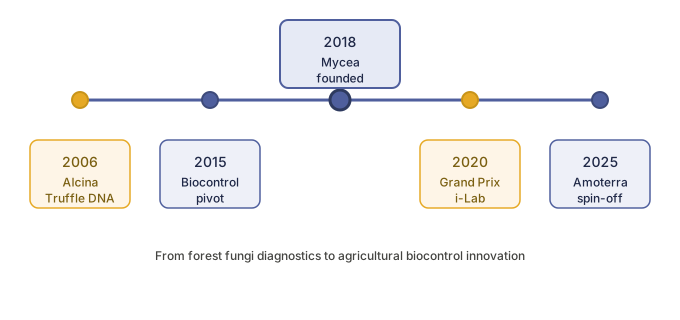
Initially, in 2006, Dominique joined Alcina, a forestry consulting firm specialising in the management of Mediterranean forests, particularly through their enhancement via edible fungi.
 The objective was to establish a laboratory where, for 10 years, she developed innovative molecular tools based on fungal DNA, which can be found in the form of mycelium, spores or mycorrhizae.
As a result, this laboratory served as a foundation for developing in-depth knowledge of these microorganisms and building a professional network around fungi.
Expanding from truffles to tree pathology
Her initial work involved analysing truffle DNA for producers. Dominique then expanded her expertise and undertook specialised training in tree diseases and their pathogenic or degrading fungi. This skill led her to conduct numerous diagnostics and studies for various local authorities, including the City of Paris’s green spaces R&D department, which sought to precisely identify the fungi affecting tree structure.
“The experts could identify the presence of rot within a tree, but they couldn’t identify the fungus causing it, nor how to treat it,” she explains.
The pivot to biocontrol in agriculture
The breakthrough: testing fungal extracts against plant diseases
The turning point came in 2015 through a decisive encounter and research results that opened the doors to what would become the future startup.
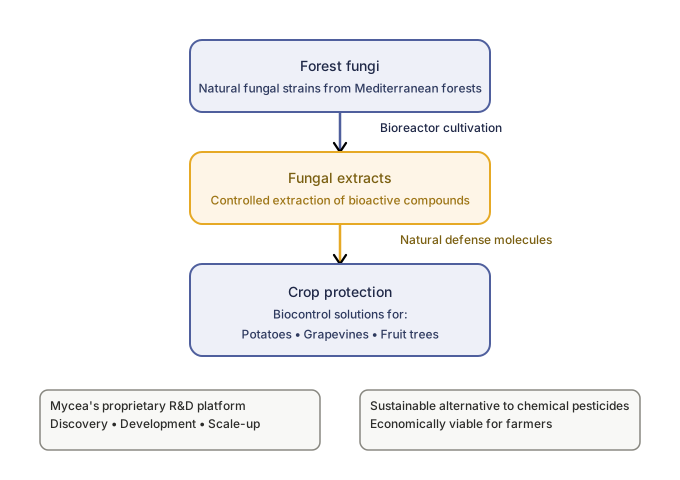
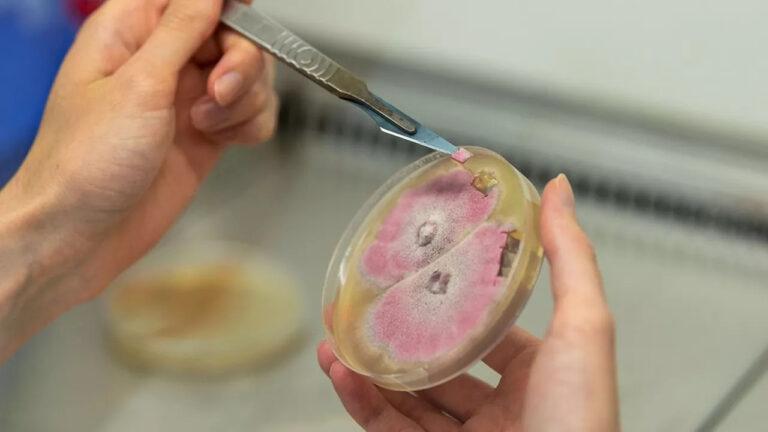
Results on the protective properties of fungal extracts against a human disease, presented by a colleague, gave her the idea to test these extracts against plant diseases. Dominique had about twenty extracts at her disposal, which she tested against several phytopathogenic fungi she had collected over the years: crop and tree diseases, wood-degrading fungi, etc.
“The initial results were very promising,” Dominique recalls. “Several extracts stopped pathogen growth.”
An idea took root: developing biocontrol products based on natural fungal extracts to replace synthetic pesticides.
Discovering mycorrhizal fungi as a soil health solution
In parallel, Dominique continued her work in green spaces and became interested in soil health in these urban vegetated areas.
While searching for a fungal marker of soil health based on endomycorrhizal fungi, she revealed significant differences in the presence of these fungi between soils in areas with and without tree dieback.
This led to the idea of reintroducing mycorrhizal fungal communities adapted to environmental conditions to increase their biodiversity in the soil and improve the vitality of plants living in symbiosis with these fungi.
Founding Mycea: a dual R&D strategy
They created Mycea to support and develop these two major R&D projects: one focused on the discovery and deployment of fungal extracts as biocontrol products for agriculture, and the other on a bioamplification service for natural mycorrhizal fungal communities to increase their biodiversity in soils.
“For me, scientific exploration takes on its full meaning when it can be transferred and applied to a field. I was committed to finding concrete solutions to implement for healthier agriculture that is less harmful to ecosystems and human health,” says Dominique.
Mycea was founded in 2018, the name deriving from “mycelium,” the network of filaments that constitutes the vegetative apparatus of fungi. For two years, the startup was incubated at LRI (Languedoc Roussillon Incubation), then joined the BIC (Business Innovation Center) of Montpellier in 2019.
A differentiating fungal R&D platform
Securing strategic investments and recognition
From the outset, Dominique Barry-Etienne structured Mycea’s scientific vision and designed a unique R&D platform centred on fungal extracts and the valorisation of natural mycorrhizal fungal communities.
Under her leadership, Mycea attracted its first investments to accelerate the discovery and development of fungal molecules for biocontrol and to establish the Mycoterroir service for regenerating mycorrhizal fungal biodiversity. The company also won the Grand Prix i-Lab 2020 for its BE-SAFE project, recognising alternative solutions to chemical pesticides.
Strategic spin-off and market positioning
At the end of 2025, after 8 years of R&D within Mycea, the soil biodiversity regeneration activity through mycorrhizal fungal amplification took flight and gave birth to Amoterra, an independent company dedicated to commercialising the Mycoterroir solution.
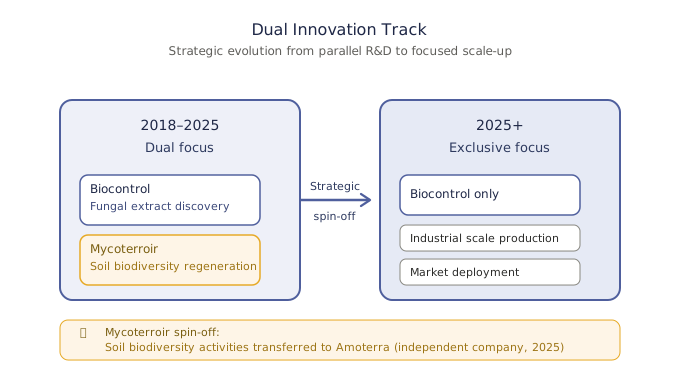
This evolution positions Mycea as a significant player in the agroecological transition, in a sector where the search for alternatives to chemical plant protection products has become a priority. Dominique Barry-Etienne brought the company into professional federations to contribute to the ecosystem’s momentum within the Association biocontrôle et biostimulation pour l’agroécologie (ABBA) and France Biocontrol.
Vision for scalable biocontrol solutions
“What matters most to me in our projects is to provide farmers with a new type of biocontrol solution to facilitate their transition to healthier agriculture while maintaining their yields. Today, I am convinced that we will develop products that are effective against numerous diseases and whose production costs will be economically viable for producers,” declares the co-founder.
Through her involvement in the French and European biocontrol ecosystem, Dominique brings to the teams in their daily work her approach to combining technologies and innovations that are crucial for developing tomorrow’s biofungicides, essential for the agroecological transition.
From lab bench to industrial scale
With over 35 years of experience in research and innovation, Dominique Barry-Etienne is among the scientists transforming their laboratory discoveries into large-scale industrial solutions. Today, the ag-biotech Mycea focuses exclusively on its activity of exploring the biological and biochemical properties of forest fungi for plant health and their large-scale production.
From truffle DNA to fungal metabolites, the journey of the agri-biotech co-founder illustrates how scientific research can serve the agroecological and economic transformation of the coming decades.